
Understanding Gregg County Releases
A release record answers when Gregg County stopped holding a person, why custody ended, and where the person went. It is not the same as an arrest record, bond amount, court judgment, or parole vote. A person normally leaves the live jail roster after a booking ends, yet the sheriff's booking and release record may remain available. Court records can preserve the legal event after current-custody visibility changes.
Gregg County's adult jail is a three-building system. South Jail, North Jail, and Marvin A. Smith Corrections Facility share county custody. Movement among them is housing, not release. Municipal police may release someone before county booking or transfer the person into the sheriff system. TDCJ, USMS, another county, and ICE are separate custodians. The destination controls where the search continues.
Gregg County Release Types
The exact label must come from the person's record. Several outcomes can end one Gregg booking, but they do not create the same status.
| Type | Meaning | Next source |
|---|---|---|
| Bond or personal bond | The person leaves jail while the case continues, unless another hold prevents it. | Jail release entry and bond docket. |
| Court order or dismissal | A judicial act authorizes release, subject to other cases and holds. | Order plus jail execution record. |
| Time served or sentence completion | The ordered county custody term is credited or complete. | Judgment, calculation, and release log. |
| Parole or mandatory supervision | A TDCJ prisoner leaves confinement under supervision. | TDCJ and Parole Division. |
| Transfer | Gregg custody ends while another agency takes control. | Receiving custodian. |
| Deceased | Custody terminates but must not be called release. | Official custodial records. |
Gregg County Release Record Fields
Match one person to one booking. Similar names, repeat arrests, and moves among Gregg buildings can otherwise join unrelated events.
| Field | What it establishes |
|---|---|
| Booked name and birth data | The identity attached to the event. |
| Booking number | The custody period that ended. |
| Arresting agency and booking time | Who began the process and when. |
| Facility | The Gregg building before release. |
| Charge, cause, and court | The case linked to custody. |
| Bond and holds | Release terms and other restraints. |
| Release date and time | When Gregg custody ended. |
| Release type or authority | The stated basis for the event. |
| Destination | Community or receiving custodian. |
| Booking photograph | The maintained image, if releasable. |
No official Gregg page promises a fixed archive term. A record disappearing online does not establish destruction. Ask whether it remains under the county retention schedule.
The destination field deserves special care. TDCJ means state intake should follow, while another county name shifts the search to that county's jail. USMS may lead to a federal docket before a BOP record exists. An ICE destination should be checked through the immigration locator. A blank destination calls for clarification, not an assumption of community release.
A photograph identifies the booking packet rather than current status. Bond data identifies terms, not the moment those terms were met. Court disposition identifies what a judge ordered, not the jailer's execution time. Each field has a limited purpose.
Request Gregg County Release Records
Use a narrow Texas Public Information Act request when online records do not state the outcome. Do not send sensitive identifiers through the sheriff's unsecured general contact form.
- Give the full name, birth date if known, booking number, and arrest date.
- Request the booking sheet, booking time, release date and time, release type, authority, destination, and receiving custodian.
- Ask for the booking photograph and bond authorization when relevant.
- Request segregable public portions and the legal basis for withheld items.
- Prefer electronic copies and ask for an itemized estimate before costs accrue.
County Judge, 101 E. Methvin Street, Suite 300
Longview, TX 75601
GreggCounty@co.gregg.tx.us
Fax: 903-237-2699
No fixed Gregg booking-photo fee or promised turnaround was verified. Charges may apply case by case.
Texas Law on Gregg Releases
Texas Government Code Chapter 552 supplies the public-information framework. It does not make every item public. Confidential information, protected law-enforcement material, juvenile records, and sealed content may be withheld or redacted. Ask for the remaining public portions.
Expunction under Code of Criminal Procedure Chapter 55A and nondisclosure under Government Code Chapter 411 are different court remedies. Neither follows automatically from release, dismissal, or discharge. Juvenile details require authorization through Juvenile Probation or the juvenile court.
Public access also depends on the office that created the record. The sheriff maintains booking and physical-release evidence. Clerks preserve court files. TDCJ maintains state incarceration and discharge history. A request sent to the wrong office may produce no responsive record even though another custodian has it.
Retention and online display are separate. Odyssey may remain visible after the live roster changes, and the sheriff may retain a packet no longer shown online. A targeted request is the archive fallback. If material is withheld, ask for public portions and the cited legal basis.
When Gregg County Releases Inmates
Texas jail standards place ordinary sentence-discharge releases between 6 a.m. and 5 p.m. and allow up to 18 hours of credit for release on the preceding day. Bond releases and specified transfers can occur overnight. That distinction helps interpret a known type, but it cannot predict an exact hour or prove that processing finished.
The Texas discharge-time rule provides timing context. The sheriff record remains proof of the actual event. Court orders, identity checks, detainers, and destination arrangements may affect when a person leaves.
Getting Home After Gregg Release
North Jail is near Longview Transit's suggested Route 4 stop at Whaley and Sixth. Suggested downtown stops also include Methvin-area locations. Longview Transit uses flag-stop service. Neither the transit agency nor the jail promises a ride or coordinates transport.
Marvin A. Smith Corrections Facility is outside the documented Longview route context. Confirm the releasing building before arranging travel. That check also prevents an internal move among North, South, and Marvin A. Smith from being mistaken for community release.
Gregg County Bond Release Proof
Gregg County Pretrial Services operates at 103 W. Whaley in Longview, while local magistrates set bail. A bond docket shows judicial authority. It does not prove that bond was posted, accepted, and followed by physical release. Another case, warrant, or detainer may keep the person in custody.
The official Pretrial Services page identifies the local channel shown below.

Pair the bond event with the jail's booking end time and disposition.
Property After Gregg County Release
Gregg County's property policy makes the release or transfer date important after roster visibility ends. Once a person enters population, property release is all or none. Clothing may be withheld without supervisory approval. When a receiving agency will not accept property, one designated representative with valid photo identification may collect it.
Weekday pickup is 8 to 11 a.m. and 1 to 5 p.m. Property remaining 30 days after release or transfer is handled as unclaimed. The listed property officer is Christie Collier at 903-236-1776. These rules concern belongings, not legal proof of release.
Gregg Courts Preserve Release Context
Gregg Odyssey and court records can preserve charges, bond events, pleas, dispositions, judgments, sentences, jail credit, probation orders, revocations, and later orders. Those entries explain why custody may change. They do not establish the moment jail staff carried out release.
The Gregg judicial records portal appears in the official capture below.
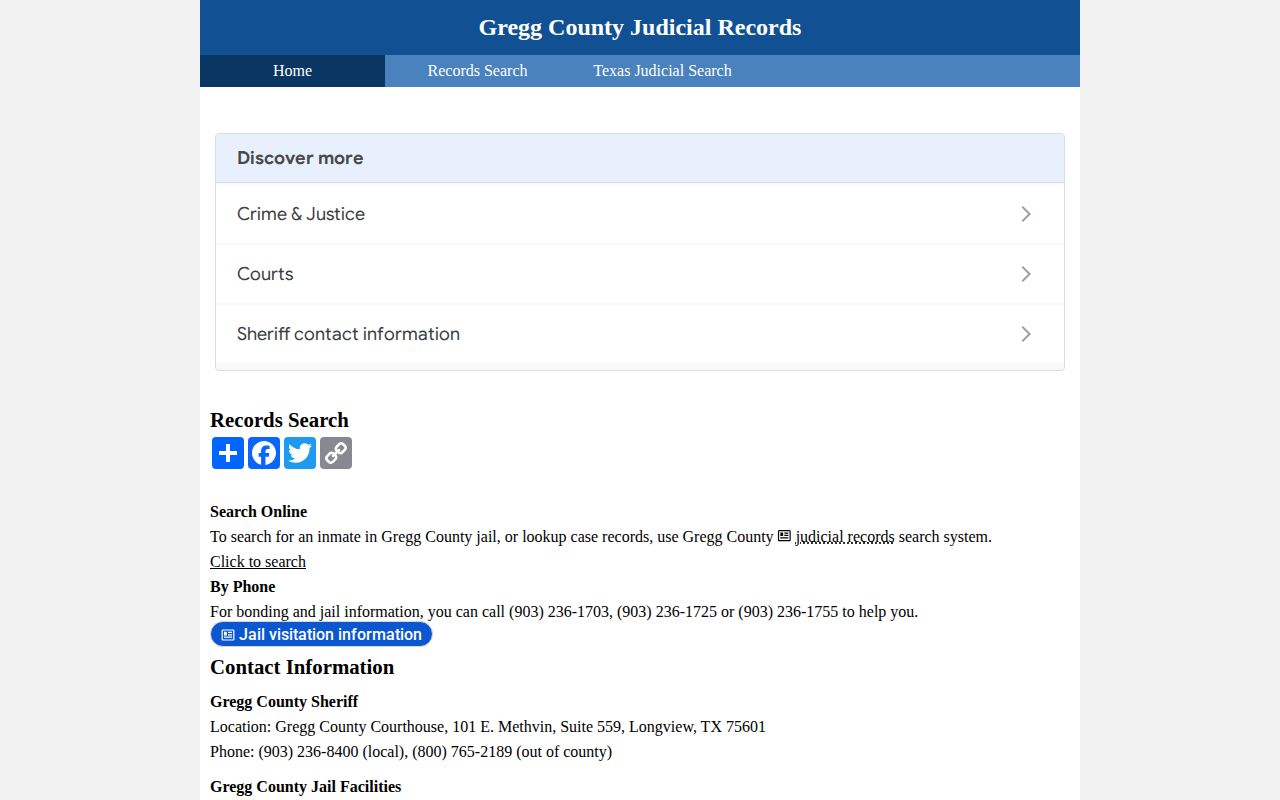
Use the judgment for judicial authority and the jail log for physical custody.
Gregg Federal and ICE Transfers
Gregg County has a documented USMS agreement for federal detention use of county jail space. Departure to USMS or a BOP institution is a transfer, not federal release. After federal designation, the BOP locator is the main public tool. Pretrial USMS custody may require the federal docket or a narrow records request.
ICE is separate. No dedicated Gregg ICE detention center was verified. If a county record names ICE, use the ICE locator and responsible ERO office. USMS, BOP, and ICE results answer different custody questions and must not be merged.
Gregg Release Collection Deadline
Gregg Court Collections tells a person subject to its order to report within three days of jail release or sentence date. This local instruction can make the actual release date important beyond a roster check. It is not a rule for every released person and does not prove that release occurred.
Read the case and collection order first. Use the sheriff release entry for the custody date, then follow the court's directions. No universal release fee was found, and no fixed Gregg release-record cost should be assumed.
Search Gregg County Released Inmates
Start with identity and the last known custodian. Collect the full name, birth date if lawfully known, arrest date, arresting agency, and booking, cause, TDCJ, SID, or BOP number. Do not accept a name-only match.
- Check the sheriff jail search for current Gregg custody.
- Search Odyssey Jail, Jail Bond, and Criminal Case Records.
- Request the Gregg release record for the exact type, time, and destination.
- If the destination is TDCJ, another county, USMS, or ICE, search that custodian.
- Check supervision or notification only when that path fits the event.
Municipal arrests add an earlier branch. Longview, Kilgore, White Oak, and Gladewater police can create records before a Gregg booking. Ask whether the person was released by the city or delivered to the sheriff. Kilgore crosses into Rusk County and Gladewater into Upshur County, so the city name does not identify the jail.
Compare dates after finding a court event. Bail setting can precede posting. A dismissal can coexist with another hold. A time-served judgment still requires jail processing. The strongest result pairs court authority with the sheriff's release date, type, and destination.
When online tools fail, move to direct records channels. A failed legacy endpoint does not prove no county record exists. TDCJ may not return every former prisoner, and USMS has no broad historical locator. A narrow request to the custodian is more reliable than repeating a broad name search.
TDCJ Search for Gregg Releases
The TDCJ online inmate search applies after admission to a Texas state prison or state jail. A Gregg record stating transfer to TDCJ means county custody ended while incarceration continued. Search by seven-digit TDCJ number or SID when available. Name results require birth data, conviction county, offense, and cause-number comparison.
| Field | Use |
|---|---|
| TDCJ or SID number | Strongest public identifier. |
| Name, gender, race | Search inputs that still require identity checks. |
| Facility and offense | Current state-custody context. |
| Projected release date | A changeable estimate, not actual release. |
| Scheduled date and location | A later plan that can still change. |
| Parole review data | Decision context, not release proof. |
The official search appears below.
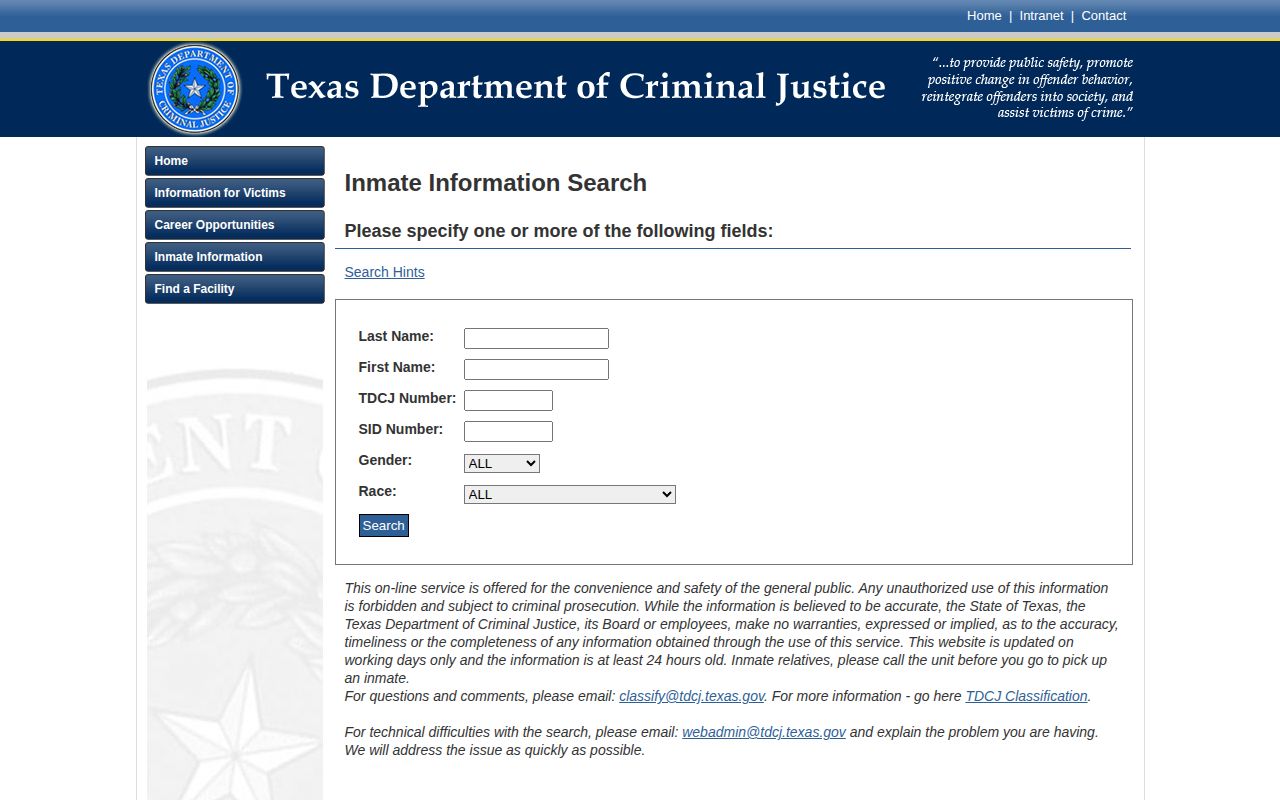
If an old record is absent, request incarceration and release history from pia@tdcj.texas.gov or call 936-295-6371 or 800-535-0283.
TDCJ distinguishes projected, scheduled, maximum-sentence, and parole-review dates. Projected Release Date is a changeable estimate. Scheduled Release Date and Location form a later plan but can still change. Maximum Sentence Date concerns expiration. Parole Eligibility Date marks possible review, not promised release.
Email requests should include the full name and TDCJ number. If unknown, give exact birth date or approximate age and conviction county. Basic information can include location, offense, incarceration history, county, court, and projected date, but not photographs. Formal certificates and discharge records use the formal request channel.
The BPP review line is 844-512-0461 before a vote. After a favorable vote, Parole Division release status is 512-406-5202. Classification and Records handles calculations at 936-437-6231 and classify@tdcj.texas.gov. Approval remains distinct from completed release processing.
Gregg County Recent Release Search
Gregg County does not publish a verified separate 24-hour or 72-hour feed. The sheriff links one legacy Odyssey Jail Inmate Search. It was unavailable during research, while the current portal sometimes redirected or looped. No official field list, update cadence, archive duration, photo guarantee, or sheriff jail app was verified.
Search the current jail record, check the court docket, call 903-236-1755, and request the release entry. Ask whether the outcome was bond, time served, court order, an internal Gregg move, or transfer. The Released Last 24 Hours workflow applies this chain to same-day events.
Gregg Release Supervision Checks
Parole is release from TDCJ confinement while the sentence continues under Parole Division supervision. Mandatory supervision is another state supervised-release route. Probation, called community supervision in Texas, comes through a court and Gregg County CSCD. A favorable Board of Pardons and Paroles vote is not physical-release proof.
- Parole
- Discretionary supervised release from TDCJ.
- Probation
- Court-ordered local community supervision.
- Discharge
- Completion of a sentence or supervision obligation.
- Time served
- Credit or completion of ordered custody, subject to holds.
Use TDCJ and Parole Division records for state supervision. Use the sentencing court and Gregg County CSCD for probation. Warrants and revocation can change status.
Gregg Release Notification Search
Gregg participation in the current county VINELink or IVSS Counties interface was not confirmed. Check the live jurisdiction selector, match one person carefully, and register only from the correct record. An alert must be verified with the custodian because data can lag.
TDCJ IVSS is confirmed for state custody, parole, and mandatory supervision. Texas launched IVSS Counties in 2025, so old VINE PIN instructions may not describe the current county workflow. The Texas sex-offender registry is relevant only when a continuing registration duty applies. No registry result proves neither release nor lack of history.
Search and registration are different. A search gives a status snapshot. Registration requests a later notice through offered channels. Keep contact data current and retain registration details. If the person transfers to TDCJ, confirm that notification follows.
Check each notice against the named custodian. A Gregg alert leads to the sheriff record. A TDCJ alert leads to state history and supervision. Federal custody lies outside both. Automated silence does not prove continued custody.
Gregg Released or Still Held
Choose the system that answers the present custody question, then use historical records for the event.
| Status | Best source | What it proves |
|---|---|---|
| Current Gregg custody | Sheriff jail search or line | Present county booking. |
| Community release | Sheriff release record | End time, type, destination. |
| State custody or release | TDCJ search and records | State status and history. |
| Parole or probation | Parole Division or CSCD | Supervision status. |
| Federal custody | BOP, docket, or USMS | Federal-system status. |
| ICE custody | ODLS and ERO | Recent immigration custody within limits. |
Gregg Release Evidence by Custodian
The Gregg County sheriff is the first custodian for an adult county booking. Its record should connect the booked identity and booking number to the physical end of custody. Ask for the release date and time, stated release authority, release type, and destination. If the person only moved between South Jail, North Jail, and Marvin A. Smith, the county booking continues. The building name can change while the custodian remains the same.
Gregg court records answer why a custody change was authorized. A docket may show a bond setting, posted-bond event, dismissal, plea, judgment, jail credit, probation order, revocation, or later order. Those events are valuable context, but they are not interchangeable with the sheriff's release log. A signed order can precede jail processing, and another hold can prevent the expected result. Pair both sources whenever exact physical release matters.
TDCJ becomes the correct custodian after state intake. Its public search can show current location, offense information, projected dates, parole review data, and scheduled release details. For a person no longer returned online, use TDCJ email, telephone, or formal public-information routes. An actual release or discharge certificate and incarceration history carry more weight than a projected date. Parole status means the person left the institution but remains under the state sentence.
Gregg County Community Supervision and Corrections Department handles local probation, while the TDCJ Parole Division handles parole and mandatory supervision. These offices confirm post-release supervision, not the county jail's exact door time. A court probation order may explain the community placement. A TDCJ parole record may establish supervised status after prison. A later warrant, absconder status, sanction, or revocation can change the result and should be checked with the responsible supervision office.
Federal evidence depends on the stage of custody. Gregg County can house a person for USMS under agreement, yet transfer back to the Marshals does not mean freedom. A federal defendant who has not reached BOP designation may be traced through the federal docket and USMS records. After designation, the BOP locator is useful. A past BOP release date with no institution supports the end of BOP custody but does not rule out supervised release or another sovereign's hold.
ICE ODLS addresses current ICE detention and a limited recent-release period. It is not a county roster and should be used only when an immigration handoff is supported by the Gregg record or other reliable source. A person absent from ODLS may fall outside its coverage or time window. Ask the responsible ERO office when the locator does not resolve a documented transfer. Do not turn a possible detainer into a confirmed ICE custody claim.
The final source is often a targeted public-information request. State exactly which booking or incarceration event is sought and ask the office to identify any receiving custodian. Keep copies of the responses and note when each search was run. Records can update at different times. A careful timeline that labels every source is stronger than one broad search result, especially when the person has local, state, and federal events close together.
Identity matching remains essential at every step. Compare the full booked name, known aliases, birth information, arrest date, charge, court cause, and agency number before joining records. Repeat bookings can create more than one valid Gregg entry for the same person. A TDCJ or BOP number identifies a different system and should not be substituted for the county booking number. When facts conflict, ask the originating offices to clarify their own entries instead of choosing the result that seems most recent.
Gregg County Release Facilities
Facility names are starting points. Follow the booking number and destination across systems.
- Gregg County Jail system: county booking and release path.
- Gregg County South Jail: adult county custody.
- Gregg County North Jail / Gregg County Jail, North Facility: an internal move is not release.
- Marvin A. Smith Corrections Facility: sheriff records control the event.
- Gregg County Juvenile Detention / Juvenile Probation detention services: authorized confidential channels.
- Longview Police Department holding/municipal arrest channel: municipal release or county transfer.
- Kilgore Police Department holding/municipal arrest channel: verify Gregg or Rusk County.
- White Oak Police Department holding/municipal arrest channel: confirm release or sheriff transfer.
- Gladewater Police Department holding/municipal arrest channel: verify Gregg or Upshur County.
- Federal prisoners housed by agreement in Gregg County Jail: departure may remain federal custody.
- ICE-related custody channel: county departure may be transfer.
No separate facility was established for Lakeport, East Mountain, Warren City, or Clarksville City. Ask the arresting agency which jail accepted custody.