
Gregg County Parole Versus Probation
Parole is conditional release from a Texas prison before the sentence has fully expired. The Texas Board of Pardons and Paroles makes the release decision, while the Texas Department of Criminal Justice Parole Division manages supervision. Probation is a sentence or court disposition imposed by a Gregg County court. The Gregg County Community Supervision and Corrections Department, or CSCD, administers that local court order. Both may set rules for reporting, travel, treatment, fees, and conduct, but their legal source and records are not the same.
A person can leave the Gregg County Jail on bond with no parole or probation at all. Another person can leave a TDCJ unit on parole yet have no Gregg jail release event that day. A third may serve a short jail term as one part of probation. The custody record proves the physical move. The supervision record proves the legal relationship that follows.
| Point | Parole | Probation |
|---|---|---|
| Authority | Texas Board of Pardons and Paroles | Sentencing court |
| Administrator | TDCJ Parole Division | Gregg County CSCD |
| Typical start | Release from TDCJ custody | Court order, sometimes after county jail |
| Best proof | TDCJ status and Parole Division verification | Judgment, docket, and CSCD verification |
| End | Discharge, revocation, or sentence expiration | Completion, early termination, or revocation by court |
Verify Gregg County Post-Release Supervision
Start with identity, not an assumed status. A full name, date of birth, TDCJ number, State Identification number, Gregg cause number, or booking number can separate people with similar names. The official TDCJ offender search is the first route for a person who served a state sentence. Gregg court and Odyssey records are the first route for probation. Neither a missing jail-roster result nor a parole vote proves that someone has walked out of custody.
- Determine whether the person was held in the Gregg jail system, sentenced to TDCJ, or placed on community supervision by a court.
- Search TDCJ by name and identifying number for state custody, parole review, release, or supervision details.
- For probation, match the Gregg County judgment and cause number through the district or county clerk record path.
- Contact the TDCJ Parole Division or Gregg County CSCD and provide enough identifiers for a reliable match.
- Confirm the physical release separately through the jail release record or TDCJ actual release data.
The Gregg County released-inmate search and release-record path explains how to obtain the booking-level exit record when supervision records do not show the precise jail departure. Keep both records. One states who had custody; the other states who supervises the person afterward.
Note: A parole eligibility date marks possible review, while an actual release date confirms that custody processing occurred.
Gregg County Parole Review Records
Ordinary Texas parole consideration does not use a public formal hearing calendar. The Board of Pardons and Paroles explains that panel members review and vote on individual files. Initial processing commonly starts about six months before eligibility, with later reviews often begun about four months before the next review date. Those are processing windows, not promised hearing dates or release dates.
Results are available through TDCJ parole-review information or the status line at 844-512-0461. FI and RMS votes can approve release with timing or program terms. NR, SA, and DMS entries can deny release or set later review. The official vote-option legend should be read with the individual result. An approval may still be withdrawn. It never substitutes for an executed TDCJ release record.
The source images document the official Texas process. The BPP review page shows how file review works.
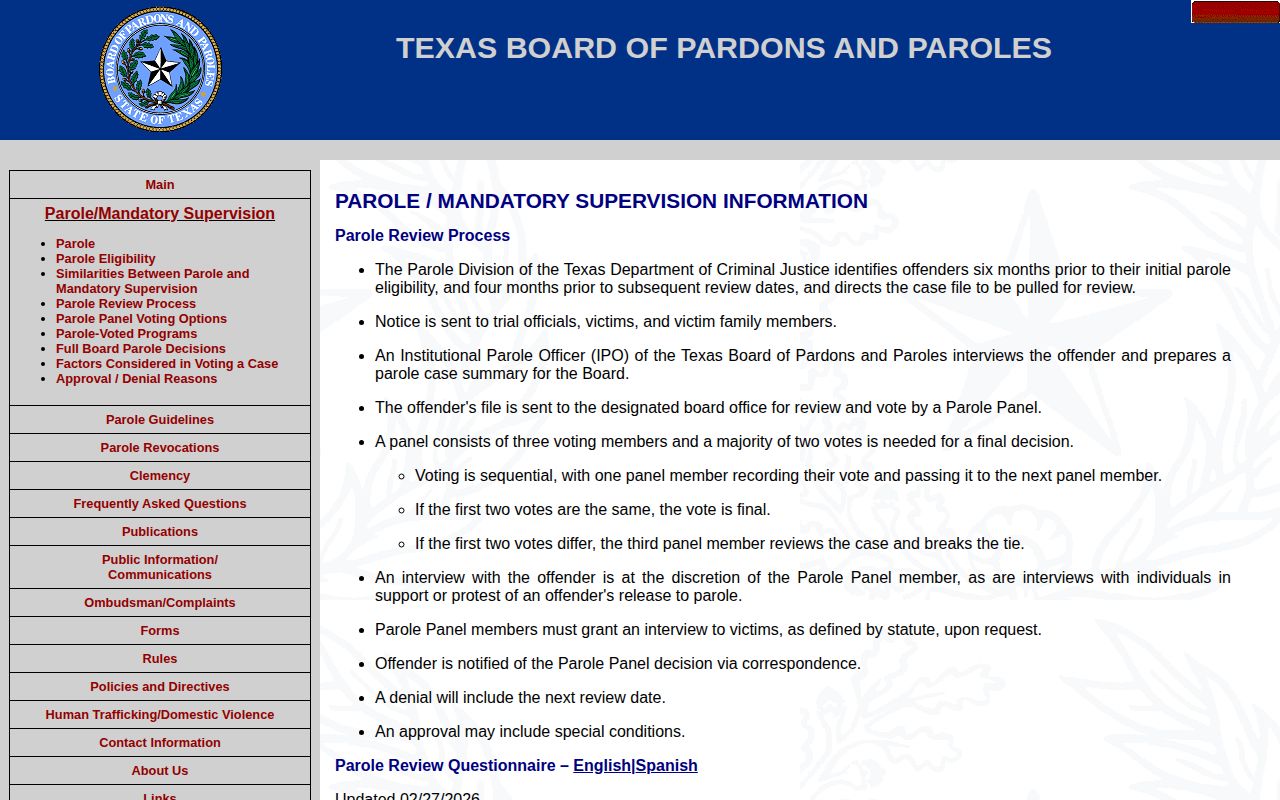
This state process applies to a Gregg County case only when the person entered TDCJ custody and became eligible for parole review.
Gregg County Supervision Offices
For state parole, use the TDCJ Parole Division office directory to identify the assigned office. The research identifies the Longview District Parole Office at 1111 Judson Road, Suite 300, Longview, TX 75601, phone 903-758-0282. Office assignment can depend on residence and TDCJ placement rather than the county of conviction, so verify the current district before relying on an old address.
Local Supervision Routes
TDCJ Longview District Parole Office
1111 Judson Road, Suite 300
Longview, TX 75601
903-758-0282
Gregg County CSCD
Use the Gregg County court judgment and official county directory to confirm the correct community-supervision unit.
A supervising officer's name may not be released through every public channel. Ask for status and office routing with a TDCJ number or cause number. Do not send sensitive personal data through an unencrypted general contact form.
Gregg County Violations and Warrants
An absconder is a person alleged to have stopped reporting or left supervision without permission. That label is not the same as a new conviction. A blue warrant is a Texas parole or mandatory-supervision warrant. Probation violations proceed through the sentencing court, while parole allegations use TDCJ and Board procedures. The record may show a warrant, hearing, sanction, continued supervision, intermediate placement, or revocation.
Check the agency that owns the supervision record. TDCJ Parole Division can address parole status. Gregg County court dockets and CSCD can address probation. If a person is arrested on a supervision warrant, the current jail record may show the hold, but the final outcome comes from the proper revocation process. Release notifications can signal a status change, yet they do not define the legal result.
Gregg County Supervision Terms Defined
Texas records use short labels that can mislead readers. Read each one in the context of the sentence and agency.
- Mandatory supervision
- A statutory form of supervised release for eligible TDCJ cases, subject to the rules and exclusions in Chapter 508.
- Parole eligibility
- The earliest point at which review may occur, not a grant or release promise.
- Discharge
- The formal end of a sentence or supervision term as recorded by the responsible agency.
- Revocation
- A decision ending community supervision and returning the case to custody or court sentencing authority.
- Detainer
- A request or hold from another agency that may block community release or cause a transfer.
Government Code Chapter 508 governs much of Texas parole and mandatory supervision. Article 42A.054 identifies listed serious offenses relevant to some parole calculations. The exact offense date and sentence matter. Broad rules of thumb are not safe substitutes for the actual record.
Property After Gregg County Release
Gregg County's property policy creates a practical reason to pin down the true release or transfer date. The sheriff's written policy allows an inmate in population to release property on an all-or-none basis. It also permits one designated representative with photo identification to collect transfer property during stated weekday windows. Property is treated as unclaimed after thirty days.
An internal move among South Jail, North Jail, and Marvin A. Smith Corrections Facility is not release. A transfer to TDCJ or another custodian is also different from community release. Ask the jail for the booking-level disposition before planning a pickup. The property rule does not prove where the person went, but its dates can help identify which office now controls the item.
Note: Confirm current pickup rules with the Gregg County jail before travel because the published policy and operational access can change.
Ending Gregg County Supervision
Parole ends through discharge, sentence expiration, revocation, or another formal TDCJ action. Probation ends under the court's order, including successful completion, authorized early termination, or revocation. A person who completes supervision may still have a public conviction or custody record. Discharge does not create expunction or nondisclosure by itself.
Obtain the closing record from the agency that controlled supervision. For parole, request TDCJ incarceration and supervision history when the public search is not enough. For probation, use the judgment, later court orders, and CSCD verification. Pair that closing record with the actual jail or prison release document when the precise custody exit matters. That record chain distinguishes release, transfer, supervision, and final discharge without guessing from an absent roster name.
Public Record Search
Sponsored Results